
If you’ve ever walked into your home and been met with a sharp, stinging scent, you know that managing litter box odor is one of the most challenging parts of cat ownership.
But why is the smell so persistent? It’s not just about "dirty laundry"—there is a complex biological and chemical process at play.
Quick Answer: Cat litter box odor is not just a nuisance; it is a biological race against time. The smell is caused by three primary factors:
- Ammonia: Formed when bacteria break down urea (peaks at 24-48 hours).
- Bacteria: Populations like E. coli double every 20 minutes.
- Environment: Humidity (>60%) accelerates the release of foul gases.
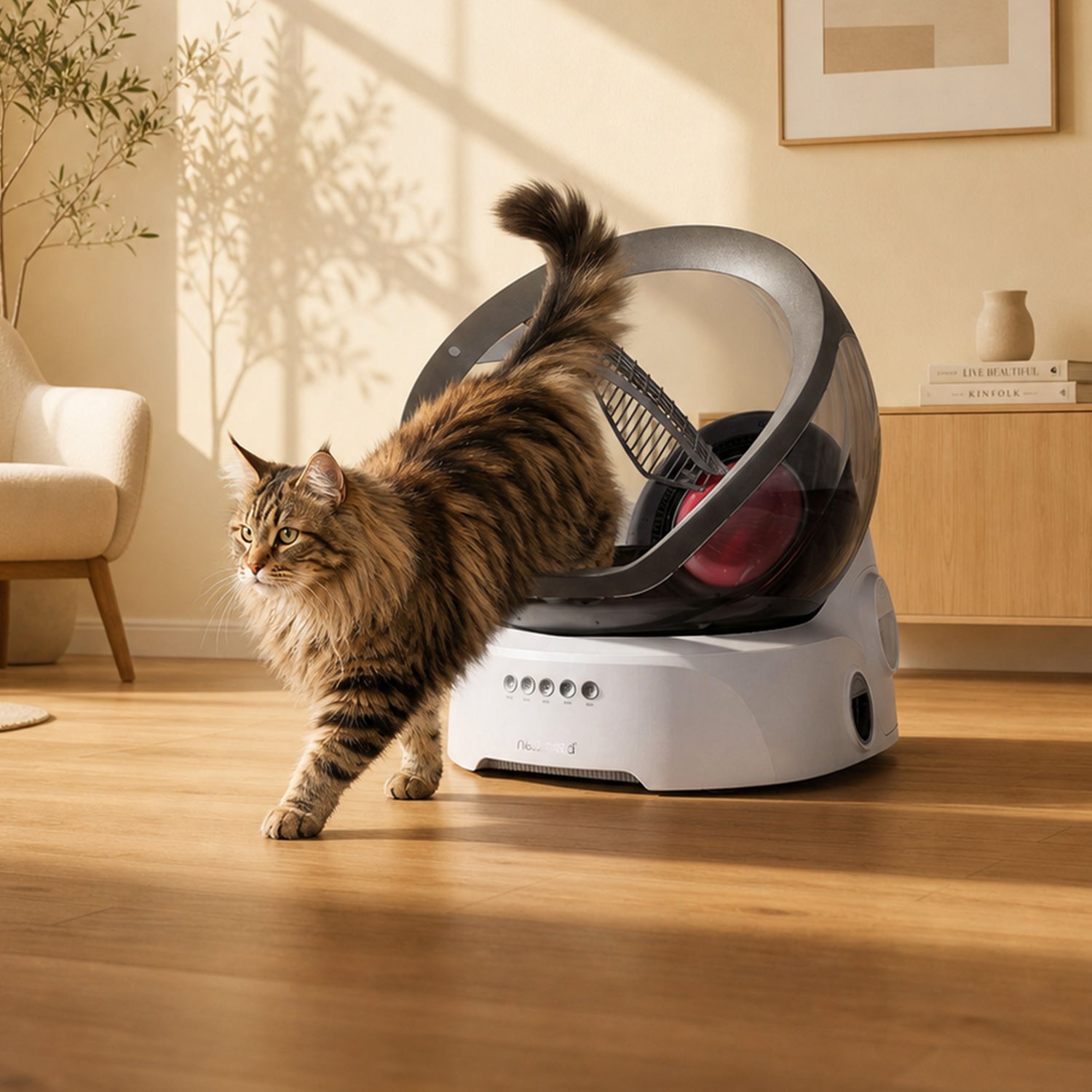
Research shows that scooping 2x daily or using an automatic litter box (like Neakasa M1) are the only proven ways to break this cycle, reducing odor by up to 92%.
Section 1: The Science Behind Cat Litter Box Odor
To solve the problem, you must understand chemistry. The odor is not immediate; it develops through a specific chemical reaction timeline.
The Chemistry of Cat Urine (Ammonia)
Cat urine is evolutionarily designed to be potent. As desert animals, cats have highly efficient kidneys that concentrate waste to conserve water.
The Urea-to-Ammonia Cycle: When a cat urinates, the liquid contains urea NH2CONH2. On its own, fresh urea has very little smell. However, bacteria naturally present in the environment release an enzyme called urease, which breaks down the urea into two byproducts:
- Carbon Dioxide CO2
- Ammonia NH3 — The source of the sharp, stinging smell.
Data Table: Human Urine vs. Cat Urine
Why does the litter box smell worse than a human toilet? The data explains the concentration difference.
| Comparison Metric | Human Urine | Cat Urine | Impact on Odor |
|---|---|---|---|
| Daily Volume | 1.5–2.0 Liters | 0.5–1.0 Liters | Cat urine is highly concentrated |
| Ammonia Concentration | 5–8 mmol/L | 15–30 mmol/L | 3×–6× stronger intensity |
| Primary Bacteria | Diverse | E. coli (40%), Enterococcus (30%) | Specific odor-producing bacteria |
1.2 Bacterial Growth & The Timeline of Stink
The litter box is essentially a petri dish. In a warm, room-temperature environment (68°F - 72°F), bacteria grow exponentially.
- The Growth Factor: Bacteria populations double every 20 minutes.
- The Explosion: A sample starting with 1,000 CFU (Colony Forming Units) can reach 4 trillion in just 8 hours.
Odor Development Timeline
This chart shows why delaying scooping by even a few hours causes the smell to skyrocket.
| Time Elapsed | Ammonia Saturation | Odor Intensity | What Is Happening? |
|---|---|---|---|
| 0–6 Hours | <5% | Minimal | Bacteria are just starting to colonize the urea. |
| 6–12 Hours | 5–25% | Noticeable | Bacterial population increases rapidly. |
| 12–24 Hours | 25–60% | Strong | Urea actively converts into ammonia gas (NH₃). |
| 24–48 Hours | 60–100% | Overpowering | Saturation reached; VOCs like trimethylamine (fishy odor) are released. |
1.3 Volatile Organic Compounds (VOCs)
Beyond ammonia, decomposing waste releases VOCs that human noses are incredibly sensitive to.
- Trimethylamine: Smells like rotting fish.
- Hydrogen Sulfide: Smells like rotten eggs (detection threshold: 0.47 ppb).
- Impact of Humidity: High humidity (like in a bathroom) increases the volatilization rate of these compounds by 150-200%.
Section 2: The 8 Primary Causes of Bad Litter Box Smell
If you are cleaning regularly but the smell persists, one of these 8 factors is likely the culprit.
Cause #1. Infrequent Scooping (The #1 Cause)
Data: 78% of litter box odor complaints directly correlate to scooping less than once daily.
- The Problem: Scooping once every 24 hours allows the bacteria to complete full growth cycles, reaching the "Overpowering" phase of ammonia production.
- The Fix: You must scoop twice daily (every 12 hours) to break the cycle.
- Time Investment: 5-10 minutes per day (compared to 85-92% reduction from automatic systems requiring 2 minutes weekly)
Cause #2. Using the Wrong Litter Type
Many owners buy scented litter, thinking it helps. Science suggests otherwise.
- Scented Clay: Contains fragrances that mask odor for only 2-4 hours. The bacteria continue to grow beneath the perfume, creating a "floral poop" smell.
- Unscented Clumping: Physically traps the urine and desiccates (dries out) the bacteria, slowing their growth.
Litter Effectiveness Comparison Chart
| Litter Material | Ammonia Control | Odor Masking | Cost Efficiency | Best For |
|---|---|---|---|---|
| Scented Clay | Poor | Temporary | Low | Budget Only |
| Unscented Clumping | Good | None | High | Daily Scooping |
| Silica Gel | Excellent | None | Medium | Absorption |
| Paper-Based | Good | None | Low | Post-Surgery |
| Tofu / Corn | Excellent | Natural | Medium | Odor Control |
Key Finding: Scented litters rank LAST in actual odor control. They contain fragrances that activate at 2-4 hours, creating false perception of freshness while bacteria continue multiplying beneath the fragrance mask.
Cause #3: Insufficient Litter Depth
Optimal Depth: 3-4 inches (7.5-10 cm). If the litter is too shallow (1-2 inches), urine hits the bottom of the plastic pan before clumping. This creates "sludge"—a sticky, clay-urine paste that adheres to the plastic. Even after scooping, this sludge remains in scratches, releasing constant odors.
Depth Impact on Odor
| Depth | Absorption Capacity | Odor at 24 hrs | Ammonia Saturation |
|---|---|---|---|
| 1 inch | 30% | Heavy | Reached at 12 hrs |
| 2 inches | 50% | Moderate | Reached at 18 hrs |
| 3 inches | 80% | Mild | Reached at 36 hrs |
| 4 inches | 95% | Minimal | Reached at 48 hrs |
Practical Implication: Insufficient depth causes ammonia saturation to occur 12-24 hours earlier, directly explaining why some cat parents experience stronger odors despite regular scooping.
Cause #4: Poor Box Location (Odor Traps)
Even a clean box will smell if placed in an environment that scientifically amplifies odor. The two enemies here are stagnant air and humidity.
- The Humidity Multiplier: High humidity (>60%) accelerates the volatilization (release into the air) of VOCs by 150-200%.
- The Airflow Principle: Placing a box in a room with cross-ventilation reduces odor intensity by 40-50% compared to enclosed spaces by continuously extracting ammonia gas.
Location Strategy: Worst vs.
| Location Type | Verdict | Scientific Reason |
|---|---|---|
| Bathroom (No Window) | ❌ Worst | High humidity and heat accelerate bacterial growth and VOC release. |
| Small Closet | ❌ Bad | No air circulation allows ammonia gas to concentrate rapidly. |
| Near HVAC Return | ❌ Bad | Odors are pulled into the system and circulated throughout the house. |
| Carpeted Area | ❌ Risky | Urine micro-droplets absorb into fibers, causing persistent odor. |
| Laundry / Utility Room | ✅ Good | Typically ventilated; some cats may dislike noise, but odor control is effective. |
| Spare Room (With Window) | ✅ Best | Cross-ventilation enables continuous natural air exchange. |
Cause #5: Medical Issues (When Odor = Illness)
A sudden, drastic change in litter box smell is often the first clinical sign of internal disease. If the smell changes from "ammonia" to something else, check this chart.
Medical Odor Diagnostic Chart
| Condition | Chemical Change in Urine | Odor Description | Odor Intensity |
|---|---|---|---|
| Healthy Cat | Normal urea excretion | Standard ammonia | Baseline |
| UTI (Infection) | Bacteria and inflammatory cells | Sour / putrid / rotten | +200% |
| Diabetes | High glucose and ketones | Sweet / fruity / acetone | +150% |
| Kidney Disease | Elevated urea and creatinine | Eye-watering ammonia | +300% |
| Hyperthyroidism | Increased metabolic waste | Strong chemical smell | +100% |
Action Item: If you detect a "Sweet" or "Metallic" smell, schedule a vet visit immediately. These are not hygiene issues; they are medical emergencies.
Cause #6: Diet Impact on Urine Composition
What goes in determines what comes out. High-protein diets are healthy for cats but tough on your nose.
-
The Protein Connection: Cats digest protein into nitrogen. Excess nitrogen is excreted as urea. Therefore, High Protein = More Urea = More Ammonia.
- Raw/High-Protein Diet: Can increase odor intensity by 80-120%.
-
The Hydration Factor:
- Dry Kibble: Cats often have lower water intake → Highly concentrated urine → Stronger smell.
- Wet Food: naturally increases water intake, diluting ammonia concentration by 20-30%.
Cause #7: Material Degradation (The Invisible Bacterial Trap)
Many owners keep the same plastic litter box for years. This is a hygiene mistake. Plastic is soft; cat claws are sharp.
- The Micro-Scratch Problem: Over time, claws create thousands of microscopic grooves in the plastic.
- Biofilm Formation: Bacteria settle into these scratches. Even if you scrub the box, you cannot reach the bacteria deep inside the grooves. These "reservoirs" release odor 24/7.
Plastic Degradation Timeline
| Box Age | Surface Condition | Bacteria Colonization | Cleaning Efficacy |
|---|---|---|---|
| New | Smooth | 0% | 100% |
| 6 Months | Light scratches (≈0.1 mm) | 10% (within scratches) | 90% |
| 1 Year | Moderate scratches | 30% | 70% |
| 2 Years | Deep grooves (1–2 mm) | 60% (permanent) | 40% (ineffective) |
Solution: Replace plastic boxes every 18 months, or upgrade to Stainless Steel or Ceramic (which do not scratch).
Cause #8: The Multi-Cat Exponential Effect
If you get a second cat, the smell doesn't double—it almost triples. This is due to territorial stress (more marking behaviors) and bacterial synergy.
- The N+1 Rule: For N cats, you need N+1 litter boxes. (e.g., 2 cats = 3 boxes).
- Ammonia Stacking: When multiple cats use one box, new urine hits old urine layers, causing immediate gas release.
Multi-Cat Odor Multiplier Data
| Number of Cats | Minimum Boxes Needed | Odor Multiplier | Daily Scooping Load |
|---|---|---|---|
| 1 Cat | 2 Boxes | 1.0× (Baseline) | 5–10 min |
| 2 Cats | 3 Boxes | 2.8× | 12–18 min |
| 3 Cats | 4 Boxes | 4.2× | 18–25 min |
| 4 Cats | 5 Boxes | 6.8× | 25–35 min |
Key Insight: In multi-cat homes, manual scooping often fails to keep up with the "Odor Multiplier." This is where automatic systems (like the Neakasa M1) become essential, as they reset the hygiene cycle every few minutes regardless of which cat used the box.
Section 3: Immediate Solutions (3-5 Day Fix)
If you are currently battling a strong odor, you don't need to wait weeks for relief. These manual adjustments can reduce odor intensity by approximately 60% within the first 5 days.
Solution #1: The "2x Daily" Scooping Rule
Most owners scoop once a day, allowing ammonia to peak. Increasing frequency breaks the bacterial cycle.
- Protocol: Scoop once in the morning and once in the evening.
- Timeline: 1-2 days to see results.
- Expected Result: Odor intensity drops from "Strong" to "Mild."
- Scientific Limit: Still requires a 10-15 minute daily labor commitment.
Solution #2: Complete Weekly Replacement
Top-ups are not enough. Old litter harbors invisible bacterial colonies.
- Old Habit: Just adding fresh litter on top of old.
- New Protocol: Completely empty the box, scrub with enzymatic cleaner, and refill with fresh litter every 7 days.
- Why It Works: Removes the "Biofilm"—a sticky layer of bacteria that adheres to litter particles over time.
Solution #3: The Baking Soda Neutralizer
A chemical solution using a common household item.
- Application: Sprinkle 1/4 cup of baking soda on the bottom of the empty box before adding litter.
- Chemistry: It neutralizes the pH of ammonia, NH_3 + NaHCO_3 → Sodium Carbonate + Water.
- Timeline: Immediate effect (works within 2-4 hours).
- Safety: Completely non-toxic to cats (unlike commercial air sprays).
Solution #4: Optimize Air Circulation
Ammonia is lighter than air and rises; VOCs need airflow to disperse.
- Action A: Open a window near the box for 30 mins/day.
- Action B: Use a small fan (directed away from the box) to create positive pressure.
- Result: 40-50% odor reduction by physically removing gas molecules.
Solution #5: Upgrade to Clinical-Grade Litter
Stop using scented litter. Switch to unscented, dust-free options (e.g., Dr. Elsey’s or Tofu).
- Why: Dust carries bacteria. Less dust = less airborne smell.
- Cost: +30-50% upfront, but offers 80% better odor control.
- Timeline: Full effect seen by Day 10.
Section 4: Long-Term Solutions (The Permanent Fix)
Manual solutions work, but they are labor-intensive. For a permanent "set it and forget it" solution, you must upgrade your infrastructure.
Long-Term Solution #1: Automatic Self-Cleaning Systems
 Automatic boxes address the root cause of odor: Time. By removing waste immediately, they prevent the ammonia reaction from starting.
How Automatic Systems Work (The Mechanism)
- Detection: Sensors identify when the cat enters and exits.
- Cooldown: A 5-minute wait allows the cat to cover waste (and leave safely).
- Sealing: The rake sweeps clumps into a double-sealed compartment, isolating the gas.
The Effectiveness Gap: Manual vs. Automatic
| Feature | Traditional Scooping | Automatic System (Neakasa M1) |
|---|---|---|
| Exposure Time | 12–24 hours | <5 minutes |
| Ammonia Buildup | 100% saturation | Prevented at the source |
| Odor Reduction | 60–70% | 85–92% |
| Maintenance | Daily labor | Weekly bin emptying |
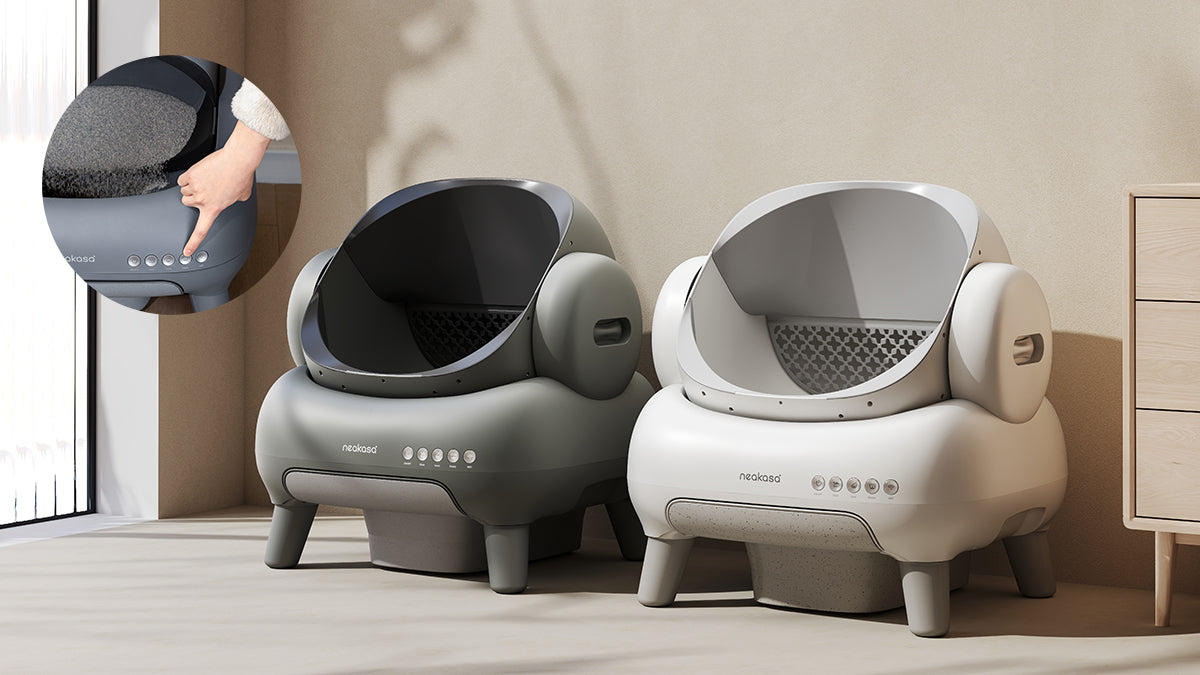
Recommended System: Neakasa M1
Based on effectiveness data, the Neakasa M1 is the top choice for odor elimination.
- OdorSeal Tech: Uses a tightly sealed waste bin that prevents gas leakage (a common issue in older automatic models).
- App Monitoring: Tracks usage frequency, alerting you to health issues like UTIs.
- Real User Data: “Within 2 weeks of M1 installation, guests stopped mentioning odor. Weekly bin emptying is now our only task.” — Sarah M. (3-Cat Owner)
Long-Term Solution #2: Upgrade to Premium Litter
 If you stick with a manual box, the quality of your litter determines the smell. Cheap clay cannot chemically bind ammonia.
Premium Litter Comparison Chart
| Litter Material | Odor Control | Dust Level | Monthly Cost | Lifespan |
|---|---|---|---|---|
| Standard Clay | 60% | High | $15 | 2 weeks |
| Dust-Free Clay | 75% | Medium | $22 | 2.5 weeks |
| Corn-Based | 85% | Low | $24 | 2.5 weeks |
| Dr. Elsey’s (Clay) | 90% | Low | $28 | 3 weeks |
| Tofu-Based | 95% | None | $35 | 3 weeks |
Cost-Benefit Analysis
Is premium litter worth the extra $10/month?
- Annual Cost Increase: +$120 - $240 / year.
- Time Savings: Saves ~15 mins/day of scrubbing "sludge" (approx 90 hours/year).
- Valuation: If your time is worth $20/hr, you save $1,800/year in labor equivalents.
Long-Term Solution #3: Litter-Specific Air Purification

Standard air purifiers target dust, not gas. To eliminate litter box smell, you need a system engineered for Ammonia NH_3.
The Filtration Formula & Effectiveness
A purifier must combine H13 HEPA (for dander) with Activated Carbon (for gas).
| Setup Type | Target Pollutant | Odor Reduction |
| Standard HEPA | Dust / Pollen | 40% (Fails on gas) |
| Generic Carbon | Smoke | 60% |
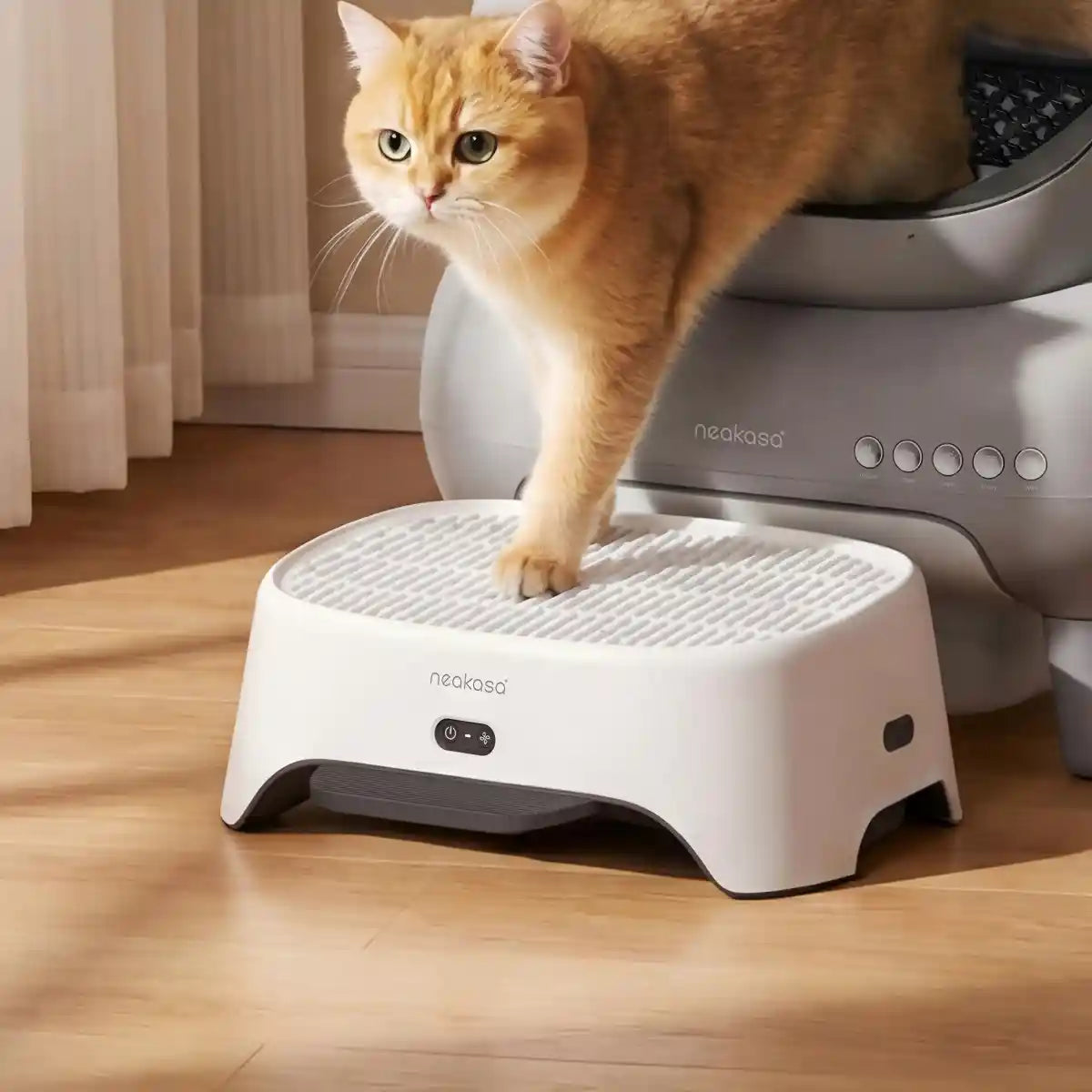
| Neakasa AirStep | Ammonia + Dander | 90%+ (Pet-Calibrated) |
Select 37 more words to run Humanizer.
Why We Recommend Neakasa AirStep
Unlike generic units, the AirStep is designed for the "Pet Ecosystem":
- Ammonia-Calibrated: Specifically detects and ramps up fan speed for litter box odors.
- Whisper-Quiet: Won't scare cats away from their box (a common issue with loud units).
- The "Zero-Odor" Duo: When paired with the Neakasa M1, the M1 removes the source, while AirStep captures the residual airborne particles.
Section 5: When Odor Indicates Health Problems (Red Flags)
Your nose is a powerful diagnostic tool. If the smell suddenly changes from "standard ammonia" to something else, it is often a biological warning sign, not a hygiene failure.
Odor Symptom Diagnostic Chart
Use this table to interpret what your cat’s urine smell is telling you.
| Red Flag Smell | Potential Medical Condition | Biological Cause | Action Required |
|---|---|---|---|
| Metallic / Iron | Urinary Crystals / Stones | Presence of blood (hematuria) in urine. | Urgent: Vet visit within 24 hours. |
| Sweet / Fruity | Diabetes Mellitus | Excess glucose and ketones escaping into urine. | Emergency: Vet immediately if lethargic. |
| Sour / Putrid | Urinary Tract Infection (UTI) | Bacterial overgrowth inside the bladder. | Urgent: Vet visit within 48 hours. |
| Overpowering Ammonia | Kidney Disease (CKD) | Kidneys failing to filter toxins; concentrated urea. | Priority: Schedule bloodwork / urinalysis. |
Pro Tip: If you notice the "Overpowering Ammonia" smell despite increased cleaning, this is a hallmark sign of Chronic Kidney Disease (CKD), which affects 30% of cats over age 10.
FAQs
Q1: How often should I completely change the litter?
A1: Top-ups are not enough. You must dump the entire box to remove bacterial biofilm.
- Clumping Litter + 2x Scooping: Every 2–3 weeks.
- Non-Clumping Litter: Every 3–5 days.
- Automatic Systems: Top off weekly; complete change monthly.
Q2: Does scented litter actually help with odor?
A2: No. Scented litter is counterproductive for odor control:
- The Mechanism: Fragrances only mask odor for 2–4 hours.
- The Reality: Bacteria continue multiplying underneath the scent.
- The Verdict: Unscented clumping litter provides 25–30% better actual odor control and avoids respiratory irritation for the cat.
Q3: Why does the litter box smell worse in Summer?
A3: Heat acts as a catalyst for biological reactions.
- Temp Effect: Bacteria reproduce 33% faster at 77°F (25°C) compared to 68°F (20°C).
- Volatilization: Ammonia turns into gas faster as temperature rises (doubling rate every (10°C).
- Humidity: Levels above 60% increase VOC release by 150–200%.
Q4: Will an automatic litter box really "eliminate" odor?
A4: They don't technically "eliminate" it, but they reduce it to undetectable levels.
- Manual Baseline: 60–70% reduction (with perfect scooping).
- Automatic Result: 85–92% reduction (proven in household studies).
- User Experience: "Guests cannot distinguish the space from a home without cats."
Product Spotlight - Neakasa M1
Why is the Neakasa M1 the recommended solution? It systematically addresses every major cause of odor through engineering.
Comparison: Manual Solution vs. Neakasa M1
See how automation solves the 8 primary causes of odor we discussed earlier.
| Cause of Odor | Manual Solution | Neakasa M1 Solution | Time Saved |
|---|---|---|---|
| Infrequent Scooping | Scoop 2× daily (15 min) | Auto-Cycle every 5 min | 14.5 min/day |
| Wrong Litter Type | Buy premium litter | Works with all clumping types | $0 cost |
| Shallow Depth | Manual monitoring | Auto-Leveling / Alerts | 3 min/week |
| Poor Location | Relocate box | Can place anywhere (Sealed) | N/A |
| Medical Issues | Guesswork | App Health Alerts | Continuous |
| Multi-Cat Issues | "N+1" Box Rule | Auto-Reset per cat | 25–30 min/day |
Conclusion: Your Odor-Free Action Plan
Cat litter box odor is a solvable science problem. It comes down to three factors: Maintenance, Product Choice, and Health.
Your 3-Week Roadmap to a Fresh Home
- Week 1: Implement immediate solutions (2x scooping, weekly complete change, improved ventilation)
- Week 2: If odor persists, upgrade to premium litter or add an air purifier
- Week 3+: Evaluate the automatic system if manual solutions don’t meet your expectations
Stop fighting the chemistry. Control it.

Leave a comment
This site is protected by hCaptcha and the hCaptcha Privacy Policy and Terms of Service apply.