

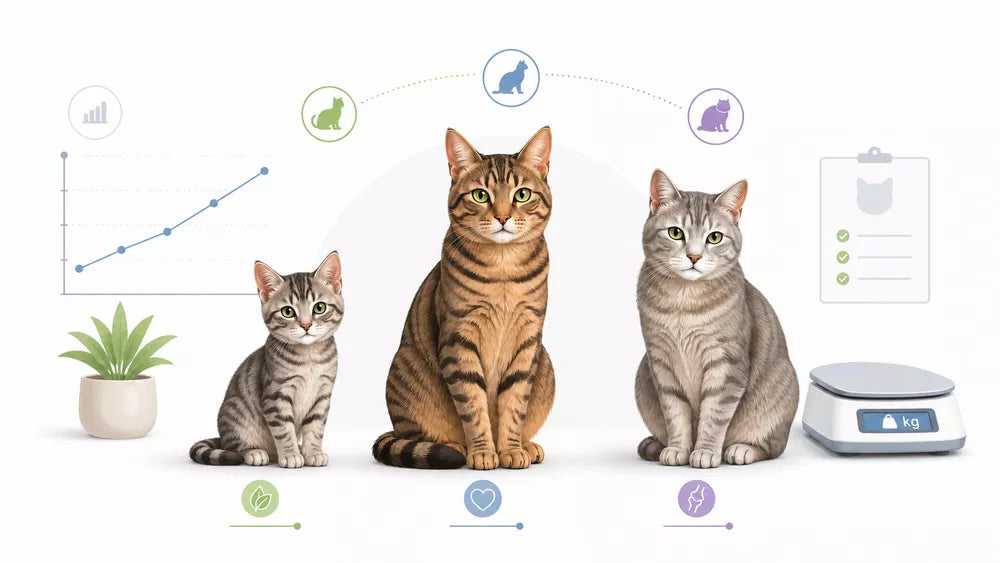
Every cat owner wonders at some point: Is my cat too skinny, or have they had a few too many treats? While stepping on the scale is a great starting point, understanding your feline friend’s health requires more than a single number. A comprehensive cat weight chart considers age, breed, and body condition to give you the full picture.
Consistency is key to monitoring feline health. Use this simple template to create a logbook at home, or consider a smart self-cleaning litter box to help track weight and litter box habits over time.
- Average isn’t everything: Most domestic cats weigh between 8 to 12 pounds, but healthy weights vary drastically by breed and frame size.
- Age matters: Kittens gain weight rapidly, while senior cats may naturally lose muscle mass.
- BCS is your best tool: The Body Condition Score (BCS) is a visual and physical assessment that is often more accurate than a standard scale.
- Sudden changes are red flags: Rapid weight loss or gain warrants an immediate veterinary visit.
Cat Weight Chart by Life Stage
Tracking your cat’s development from kittenhood to their senior years is crucial for catching health issues early. As your cat ages, their metabolism and activity levels change, which directly impacts their ideal weight. Below is a general cat weight chart categorized by life stage for a standard domestic cat.
| Life Stage | Age Range | Average Healthy Weight Range | Milestone Notes |
|---|---|---|---|
| Newborn | 0 - 4 weeks | 3 - 16 oz (0.2 - 1 lbs) | Should gain about 0.5 oz daily. |
| Kitten | 1 - 6 months | 1 - 6 lbs | Rapid growth phase; high caloric needs. |
| Young Adult | 6 - 12 months | 6 - 10 lbs | Growth slows down, reaching adult frame size. |
| Adult | 1 - 10 years | 8 - 12 lbs | Maintenance phase: weight should remain stable. |
| Senior | 11+ years | 7 - 11 lbs | Metabolism slows; muscle loss may naturally occur. |
Note: This chart serves as a baseline for mixed-breed domestic shorthairs. Always consult your vet for personalized goals, especially if you are caring for an older cat with changing mobility, appetite, or litter box habits. You can also review our senior cat care guide for more age-specific care tips.
Average Cat Weight by Breed: Why One Chart Doesn’t Fit All
While life stage provides a good timeline, genetics play an equally important role in determining what the scale should say. A healthy weight for a petite Siamese would be dangerously underweight for a Maine Coon.
Here is a breakdown of average weight ranges for popular cat breeds to show why a universal cat weight chart doesn’t always apply. If you live with a bigger breed, our guide to large cat breeds can help you better understand their size, personality, and home-care needs.
- Siamese & Sphynx (Small Frame): 6 to 10 pounds
- Domestic Shorthair (Medium Frame): 8 to 12 pounds
- Persian & British Shorthair (Large Frame): 9 to 14 pounds
- Ragdoll (Extra-Large Frame): 10 to 15 pounds
- Maine Coon (Giant Frame): 12 to 20+ pounds
If you have a purebred cat or a mix with distinct breed traits, always benchmark their weight against their specific cat breed standards rather than the generic average.
How to Use Body Condition Score with a Cat Weight Chart
Veterinarians often rely on a 9-point Body Condition Score (BCS) system rather than a scale alone. Think of it as a BMI calculation for pets. A score of 4 or 5 is considered ideal. Because fur can hide a lot, scoring your cat requires both visual inspection and hands-on assessment. Here is how to do it at home.
Step 1: Feel the Ribs
Place both thumbs on your cat’s spine and spread your fingers gently over their rib cage.
- Ideal: You should be able to feel the ribs easily beneath a thin layer of fat, similar to feeling the back of your hand.
- Overweight: If you have to press hard to find the ribs, your cat carries excess fat.
- Underweight: If the ribs feel sharp like your knuckles, they are too thin.
Step 2: Look From Above
Stand directly above your cat while they are standing up.
- Ideal: You should see a slight indentation or “waist” just behind their ribs.
- Overweight: The waist is completely absent, or the back widens out, resembling an oval shape.
- Underweight: The waist is severely pinched, and the hip bones may protrude.
Step 3: Look From the Side
Get down to your cat’s eye level and view their profile.
- Ideal: The abdomen should tuck upward slightly behind the rib cage (the “abdominal tuck”).
- Overweight: The belly sags down, running parallel to the floor or dragging (distinct from a normal primordial pouch).
- Underweight: The tuck is extreme, and you may see the outline of the ribs or spine.
When Your Cat’s Weight Is Too High, Too Low, or Changing Fast
Once you have consulted the cat weight chart and performed a BCS check, you might discover your cat’s weight is outside the healthy range. How you respond depends on the specific issue, as weight anomalies are often symptoms of underlying conditions.
If Your Cat Is Overweight
Feline obesity is incredibly common and can lead to diabetes, joint pain, and a shortened lifespan.
- Cut back on free-feeding: Measure meals carefully instead of leaving a bowl full of kibble all day.
- Increase activity: Introduce interactive toys like laser pointers or feather wands for 10-15 minutes a day.
- Consult the vet: Work with your veterinarian to safely reduce their daily caloric intake.
If Your Cat Is Underweight
Being consistently underweight can indicate malnutrition, parasites, or hyperthyroidism.
- Assess their food: Ensure you are feeding a high-quality, protein-rich diet suitable for their life stage.
- Check for stress: Multiple pets or environmental changes can cause cats to avoid eating.
- Medical check: Schedule a vet visit to rule out dental disease, parasites, or kidney issues.
If Your Cat’s Weight Changes Suddenly
A rapid shift in weight, either gaining or losing, is always a veterinary emergency. Sudden weight loss despite a normal appetite is a classic sign of diabetes or thyroid issues, while sudden weight gain (especially a bloated abdomen) can indicate fluid retention, heart issues, or feline infectious peritonitis (FIP). Do not wait; book a vet appointment immediately.

Printable Monthly Cat Weight Tracker
Consistency is key to monitoring feline health. Use this simple template to create a logbook at home. Weigh your cat once a month (using a baby scale, or by holding them on a human scale and subtracting your own weight) and record their BCS.
| Date | Weight (lbs/kg) | Body Condition Score (1-9) | Diet/Activity Notes |
|---|---|---|---|
| [Month 1] | |||
| [Month 2] | |||
| [Month 3] | |||
| [Month 4] |
FAQs
Q1. What Is a Healthy Weight for a Cat?
A1. Most domestic shorthair cats weigh about 8–12 pounds (3.6–5.4 kg). A healthy weight is best judged by Body Condition Score: ribs should be easy to feel, with a visible waist.
Q2. How Often Should I Weigh My Cat?
A2. Healthy adult cats can be weighed once a month. Kittens, seniors, or cats on a weight-loss plan should be weighed every 1–2 weeks.
Q3. Should I Put My Overweight Cat on a Diet?
A3. Yes, but never restrict food suddenly. Rapid weight loss can cause hepatic lipidosis, a serious liver condition. Always work with your vet on a gradual weight-loss plan.
Q4. Is a 15-Pound Cat Overweight?
A4. It depends on breed and body frame. A 15-pound Maine Coon may be healthy, but an average domestic shorthair at this weight is likely overweight.
Conclusion
Understanding your pet’s size goes far beyond simply checking a cat weight chart. By combining knowledge of your cat’s specific breed, tracking their life stage, and regularly performing a hands-on Body Condition Score, you are taking a proactive step in protecting their long-term health.
Your next steps:
- Weigh your cat today and perform the 3-step BCS test.
- Start a monthly weight tracker to look for hidden trends.
- If your cat’s BCS is outside the ideal 4-5 range, or if you notice any sudden weight changes, schedule a wellness exam with your veterinarian.



Leave a comment
All comments are moderated before being published.
This site is protected by hCaptcha and the hCaptcha Privacy Policy and Terms of Service apply.