
One cat finishes its food quickly. The other eats slowly and returns to find an empty bowl. The right automatic cat feeder for two cats can help you manage meals. Each cat also needs its own space to eat in peace.
This guide compares dual-bowl feeders with separate feeding stations. It explains how to set portions and reduce food stealing. You’ll also learn how Neakasa Riko prepares fresh meals from compatible freeze-dried food.
An automatic cat feeder for two cats should match each cat’s diet and feeding behavior. A dual-bowl model may suit cats that eat calmly, but separate feeders offer more flexibility. Cats that steal food or need different diets may require protected feeding areas or selective access. A timer alone cannot prevent food theft.
Why Feeding Two Cats Can Be Difficult
Food stealing and different eating speeds
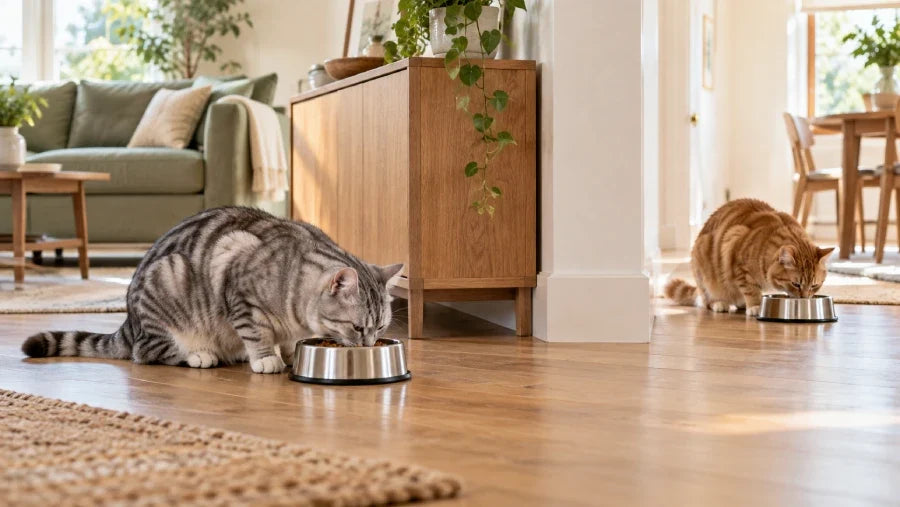
Putting down two bowls does not tell you which cat eats the food. A fast eater may finish one serving and move straight to the next. Meanwhile, the slower cat may wait until the area is quiet before approaching.
This makes a shared cat feeder for multiple cats difficult to assess. The machine might release the correct total amount while the cats receive very different shares. An empty bowl confirms that food has disappeared, but it does not identify who ate it.

Different diets and daily food needs
Two cats may need different foods or portions even when they weigh about the same. Age, activity, body condition, and health can affect their feeding plans. A kitten and an adult cat, for example, should not automatically share the same diet and allowance.
When a veterinarian prescribes a particular diet, ask how to keep that cat’s meals separate. Feeding each pet from its own bowl makes individual meals easier to manage.
Signs Your Cats Need a Different Feeding Setup
Watch what happens before and after meals
Observe a few meals from food preparation through cleanup. Does one cat wait beside the dispenser? Does the other approach and then turn away? Does one move between both bowls after finishing?
Cats do not have to fight to show tension at mealtime. One may hesitate to approach or avoid the feeding area. Even if both eat side by side, they may not feel comfortable.
Track each cat rather than the shared bowl
Keep separate notes on the amount offered, leftovers, and which cat you saw eating. This is especially useful while introducing an automatic cat feeder for multiple cats.
If appetite or weight changes, contact your veterinarian. Do not assume that every change comes from competition, or increase both cats’ portions because one appears hungry.
Choosing an Automatic Cat Feeder for Two Cats
One feeder with two bowls
A dual-bowl automatic feeder for two cats keeps the equipment in one place. It may be practical when both cats eat the same food, approach calmly, and stay with their own servings.
Check how the machine divides food. A shared hopper with a splitter may offer less control than two independently managed dispensing channels. Ask whether you can set a different portion for each side, and test the output with your actual food.
Also watch the cats after dispensing. Even an equal split cannot stop one cat from moving to the other bowl. If you need an automatic cat feeder for 2 cats on different diets, check its food compartments. Each should store food separately and have its own feeding settings.
Two independent automatic feeders
Two feeders let you choose separate locations and settings. One cat can eat in a quiet bedroom while the other eats elsewhere. You can also select different equipment for different foods.
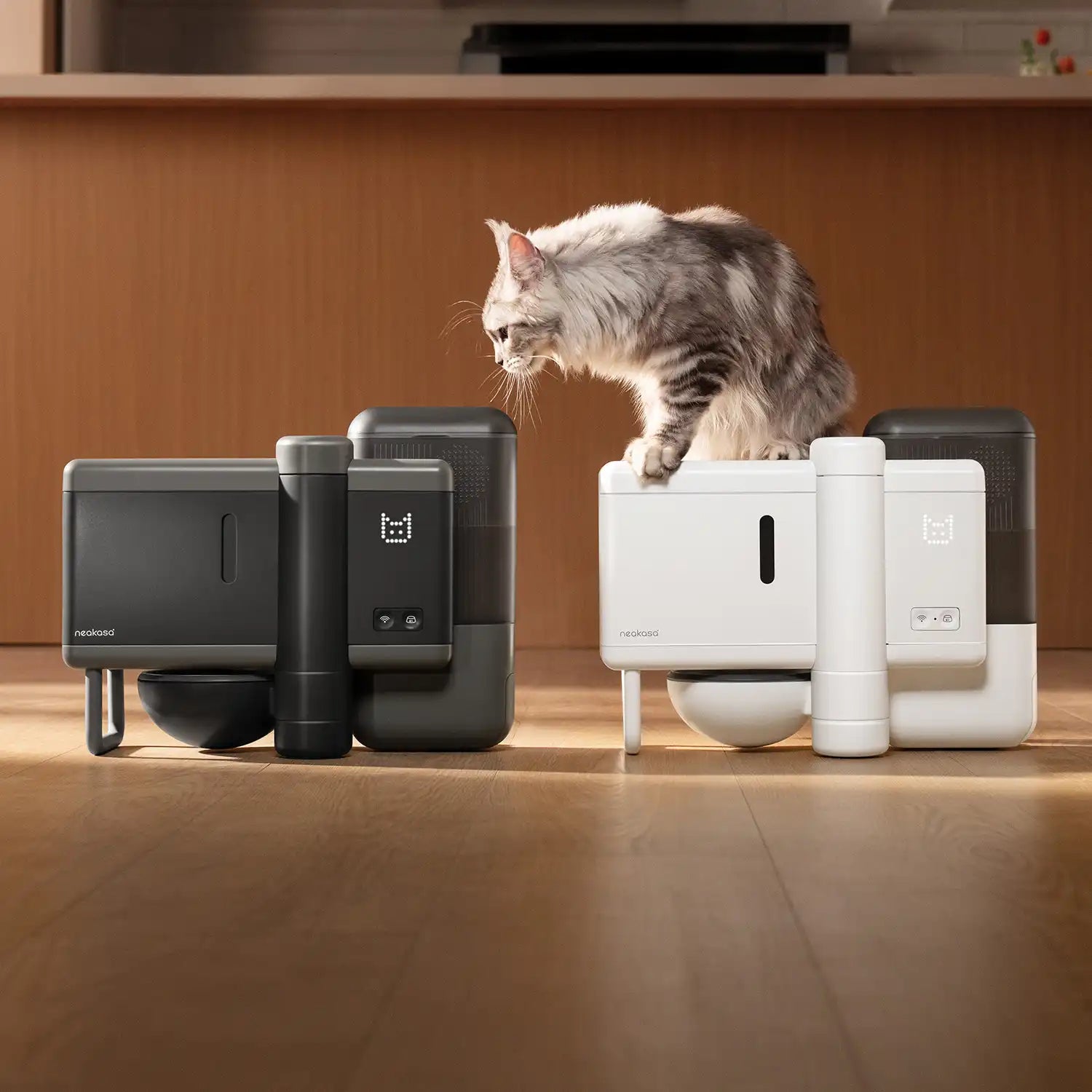
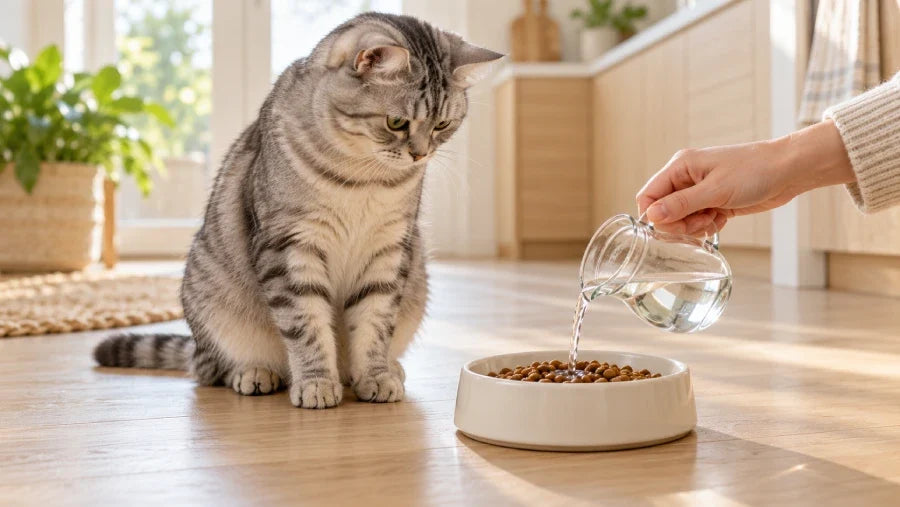
For a cat eating compatible freeze-dried food, Neakasa Riko can be used at a separate feeding station. Mix mode grinds the food and adds room-temperature water at mealtime. Food Only mode serves ground freeze-dried food without water, while Water Only mode dispenses water.
Two machines still require an access plan. If both cats can wander between them, the faster eater may simply visit both. Choose this arrangement for flexibility, then test whether separation is sufficient.
| Setup | Suitable situation | Portion control | Food compatibility | Access limitation |
|---|---|---|---|---|
| One dual-bowl feeder | Calm cats sharing a diet | Check whether both sides are independent | Model dependent | Nearby bowls remain accessible |
| Two independent feeders | Separate locations or feeding plans | Each device has its own settings | Can choose a device for each diet | Cats may switch stations |
Features to Check Before You Buy
Independent portions and food compatibility
When comparing an automatic pet feeder for two cats, look beyond the number of bowls. Check the smallest serving, adjustment increments, and whether each outlet follows its own settings. For any two-cat auto feeder, measure several test servings to see how it handles your chosen food.
Food compatibility comes next. Kibble dispensers, feeders holding prepared wet food, and machines preparing rehydrated meals serve different purposes. Match the device to what each cat actually eats. For any main diet, confirm that the food is complete and balanced for the appropriate life stage.
Power backup and daily maintenance
Read what happens during a power outage or internet interruption. Find out which functions continue locally, what requires an app connection, and whether backup power is included.
Compare the cleaning routine, too. Can you remove food-contact parts easily? Are replacement bowls and consumables available? Measure the space with the feeding bowl extended, leaving room for the cat to approach. A compact machine is less useful if it blocks a doorway or creates a crowded eating spot.
How to Feed Cats Separately With Automatic Feeders
Create separate feeding stations for cats
Start with an individual eating place for each cat. FelineVMA recommends visual separation between feeding areas so cats do not have to watch one another while eating.

Different rooms can make the arrangement easier to manage. If that is impractical, try stable furniture or an opaque divider that breaks the direct view between stations. Keep both locations accessible, especially for an older cat or one with limited mobility. Do not rely on jumping to a high surface as the only way to reach food.
Match schedules to the feeding spaces
With separate, protected spaces, both cats may be able to eat at the same time. Staggered meals are another option when you can control access to each feeding area.
For example, if Riko is set up for one cat’s midday meal, decide where the other cat will be during that serving. Programming a later time for the second cat will not, by itself, keep that cat away from the first station.
Supervise the first automatic meals
Test the complete routine while you are home. Watch each cat approach, eat, leave, and return. Check whether the faster eater investigates the other station.
If a cat hesitates, introduce the equipment gradually using familiar food and supervised sessions. Review the location before adding more automatic meals. A useful setup is one both cats can use comfortably, including after the first few bites.
Set Portions for Each Cat
Use an individual daily food allowance
Set a daily food amount for each cat. Then divide it into meals. Check the food’s calorie content and follow your veterinarian’s advice. This is especially important for cats on a therapeutic diet or weight-management plan. Adjust portions and meal times to each cat’s needs.
Once you know the calorie allowance assigned to a particular food, convert it into grams:
Food amount in grams = calories allocated to that food ÷ calories per gram
For example, say a food contains 4 kcal per gram. A 180 kcal portion would equal 45 g of food. This example shows how to calculate the amount. It is not a recommended daily portion for your cats.

For a closer look at labels and food amounts, read our guide to how much a cat should eat a day.
Check leftovers and food eaten elsewhere
Include treats, toppers, hand-fed meals, and food from other dispensers in each cat’s total. Use a simple log with separate columns for food offered and leftovers.
Keep device records in context. A scheduled serving confirms what the machine was instructed to provide; direct observation helps you check what happened next. When cats can share access, you may need supervised meals to understand their individual intake.
When Your Household Needs More Than Two Feeding Stations
Add access and space as the household grows
When another cat joins the household, review the whole arrangement before increasing the shared food supply. Ask where the new cat can eat and whether the existing cats can still reach their own meals without interruption.
Choosing an automatic feeder for multiple cats involves more than buying a larger hopper. You may need another device, an additional protected feeding area, or different timing with controlled access.
An auto cat feeder for multiple cats should fit the household’s actual behavior. Recheck the setup whenever diets change or a cat begins avoiding a station. Equipment that worked for two relaxed companions may need a different layout after a new arrival.
Where Neakasa Riko Fits in a Two Cat Feeding Routine
A separate station for compatible freeze dried meals
Make daily meal prep easier with the Neakasa Riko Fresh-Made Wet Meal Feeder. Choose from three modes: Mix grinds compatible freeze-dried food and adds room-temperature water at mealtime; Food Only serves ground freeze-dried food without water; Water Only dispenses water. Use the Neakasa App to schedule meals around your cat’s routine. For main meals, choose compatible freeze-dried food labelled complete and balanced for your cat’s life stage. Freeze-dried treats should not replace a complete diet.

- Three flexible modes: Mix mode grinds compatible freeze-dried food and adds water at mealtime. Food Only mode serves ground freeze-dried food without water. Water Only mode dispenses water.
- Customizes meal texture with an adjustable 1:1–1:5 water-to-food ratio.
- Supports precise 1–20 g portions and 20+ scheduled feedings per day through the app.
- Reduces frequent refilling with a sealed 3 L food container and 2.4 L water tank.
From $214.99
This makes Riko worth considering when one cat needs a dedicated station for that food type. In a mixed-diet household, the second cat can have a separate station suited to its own food. Decide how each cat will reach its meals before choosing the equipment.
Plan food access before choosing the device
Riko comes with two stainless steel bowls for rotation during cleaning. They do not create two independently controlled feeding stations. If your cats need protected individual meals, plan separate areas or supervised access around the device.
Introduce Riko while you are home. Start with a small test meal, check acceptance, and review leftovers before expanding the schedule. Its user guide advises clearing leftovers and cleaning the bowl; adding water does not make old food fresh again. Do not load canned, pouch, or already-rehydrated food into the container.
Frequently Asked Questions
Can one automatic pet feeder for 2 cats feed both fairly
One feeder may work if both cats eat calmly from their own bowls. Check how it divides the food and watch a few meals. Equal portions do not mean each cat eats the same amount. Adjust the setup if one cat eats from both bowls or blocks the other cat’s access.
Do I need two feeders if one cat steals food
Two feeders let you set different portions and feeding locations. But one cat may still steal food if it can reach both bowls. Try feeding in separate rooms or supervising meals.
Is Neakasa Riko suitable for multiple cats
Yes. Riko can be part of a multi-cat household’s feeding routine when the food and access arrangement suit the cats. Plan who uses the station and observe meals. Treat its included bowls as cleaning replacements, rather than assuming they provide independent portions for two cats.
Can I leave two cats alone with an automatic feeder
Automatic feeding can support a tested routine while you are out, but arrange care during longer absences. Someone still needs to check the cats, water, remaining food, and equipment. Leave clear instructions for missed meals or failures rather than relying only on app notifications.
Choose the Right Feeding Setup for Both Cats
Choose an automatic cat feeder for two cats based on their diets and eating habits. Watch a few meals. Check whether either cat steals food or blocks the other. Then choose feeders and feeding spots that suit both cats.
A dual-bowl feeder may suit calm companions. Separate devices offer more flexibility, while selective access can help protect individual food. For compatible freeze-dried meals, consider Riko as part of that arrangement. Test the routine at home and keep checking that both cats have a comfortable place to eat.

Leave a comment
All comments are moderated before being published.
This site is protected by hCaptcha and the hCaptcha Privacy Policy and Terms of Service apply.