
Finding the best feeding schedule for cats starts with two questions: how often should you feed a cat, and how much food should a cat eat? For most healthy adult cats, at least two measured meals a day is a practical starting point, while the right portion depends on age, weight, activity level, body condition, and food calorie density.
Cats naturally prefer several small meals throughout the day. After eating, their stomach gradually empties over several hours, so long gaps between meals can lead to stronger hunger and may not suit every cat. A consistent cat feeding schedule helps create a predictable routine while making portion control easier.
Compared with free feeding, scheduled meals also make it easier to monitor appetite, manage weight, and notice changes in eating behavior.
- Most healthy adult cats do well with 2–3 measured meals per day, while kittens usually need more frequent meals.
- The best feeding schedule for cats should be consistent, portion-controlled, and adjusted for age, weight, activity level, health, and Body Condition Score (BCS).
- Avoid relying on cups alone. Calculate daily portions based on your cat’s calorie needs and the food’s kcal per cup, can, or gram.
- Wet or rehydrated meals can help increase daily water intake, while dry food can also be appropriate when it is complete, balanced, and properly portioned.
- Free feeding may work for some cats, but scheduled meals make it easier to control calories, monitor appetite, and prevent overeating.
- Cats with diabetes, kidney disease, urinary problems, or other medical conditions may need a veterinarian-guided feeding plan.
- In multi-cat homes, separate feeding areas can help prevent food stealing, stress, and accidental access to prescription diets.
- Automatic feeders such as Neakasa Riko can help busy cat parents maintain regular feeding times while serving portion-controlled, freshly rehydrated meals from compatible freeze-dried food.
How Many Times a Day Should a Cat Eat?
So, how many times a day should a cat eat? For most healthy adult cats, feeding at least twice a day is a practical starting point, while dividing the daily food allowance into two or three smaller meals may better match a cat’s natural preference for frequent, smaller meals. The exact schedule should still depend on your cat’s age, health, activity level, and total daily calorie needs.

Adult Cat Feeding Schedule: 2–3 Meals a Day
If you’re wondering how often to feed cats, a simple adult cat feeding schedule might look like:
- Two meals a day: morning and evening, roughly 8–12 hours apart.
- Three meals a day: morning, afternoon, and evening, with the same total daily food divided among the three meals.
VCA notes that after about 8–10 hours without food, an empty stomach begins sending hunger signals to the brain, which is one reason feeding at least twice daily works well for many cats.
Cats are also naturally adapted to eating multiple small meals. The Feline Veterinary Medical Association recommends feeding strategies that allow cats to eat smaller portions throughout the day rather than relying only on one or two large meals.
Why Feeding Once a Day May Not Be Ideal
How often do cats eat naturally? Much more often than once a day. Cats evolved as hunters that consumed multiple small prey meals over a 24-hour period rather than one large meal.
For some cats, one large daily meal also means a long stretch with an empty stomach. Smaller, more frequent meals can reduce long fasting periods and may be particularly helpful for cats prone to eating too quickly or vomiting on an empty stomach. Bilious vomiting syndrome is uncommon in cats, but when prolonged fasting contributes to bile-related vomiting, veterinarians may recommend smaller, more frequent meals.
Spreading food throughout the day can also support more natural feeding behavior and may help reduce food-focused inactivity, overeating, and feeding-related anxiety.
The key is not to feed more food. Instead, divide your cat’s normal daily portion into additional meals.
Keeping Feeding Times Consistent When You’re Away
Regular feeding times for cats can be difficult to maintain if you work long hours, commute, or are away from home during the day. A timed feeder for cats can help by serving measured portions according to a preset schedule, making consistent cat feeding easier even when no one is home.
Most conventional automatic feeders simply dispense dry kibble. Wet-food feeding presents a different challenge because prepared moist food should not sit at room temperature for extended periods.
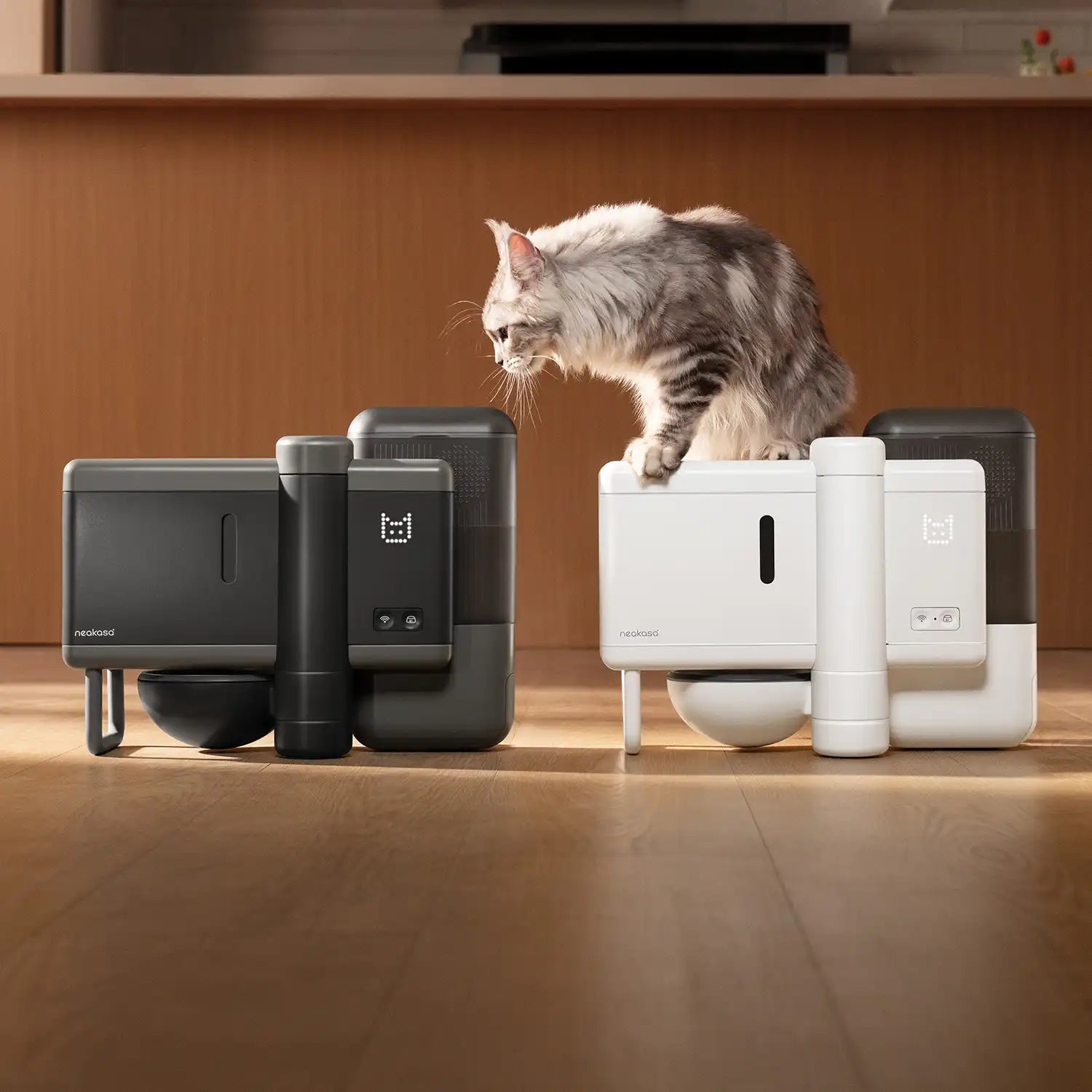
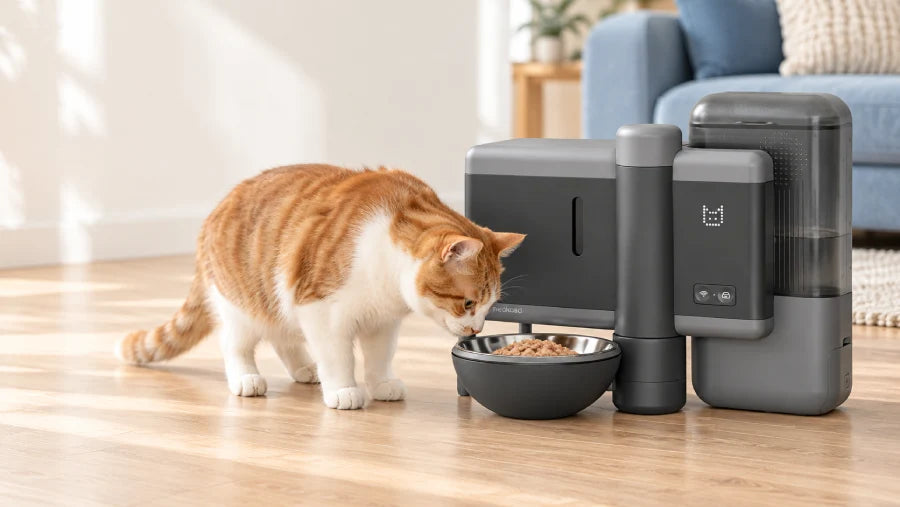
The Neakasa Riko Fresh-Made Automatic Cat Feeder takes a different approach. Instead of storing prepared wet food in the machine, Riko keeps compatible freeze-dried food dry until mealtime. At the scheduled time, it dispenses the selected portion, grinds the food, adds room-temperature water, and serves a freshly rehydrated meal.
Riko supports 20+ scheduled meals per day, so owners can divide a cat’s daily food allowance into several smaller portions when appropriate rather than relying on one or two large meals. This can be especially useful for busy cat parents who want the convenience of automatic feeding while also adding moisture to compatible freeze-dried meals.
Overall, there is no single feeding frequency that fits every cat. For most healthy adults, two meals per day is a good baseline, while two to three—or several smaller meals—may work better depending on the cat and household. What matters most is keeping the schedule consistent and dividing the correct daily amount of food, rather than increasing calories simply because you feed more often.
Cat Feeding Schedule by Life Stage
A cat’s feeding needs change as they grow. Kittens need frequent meals to support rapid development, healthy adult cats usually thrive on a consistent routine, and senior cats may need adjustments based on appetite, dental health, and age-related conditions.

Kittens: 0–12 Months
Kittens have small stomachs but high energy needs, so they generally need smaller, more frequent meals than adult cats.
A practical feeding schedule is:
- Weaning to 3 months: about 3–4 small meals per day
- 3–6 months: around 3 meals per day
- 6–12 months: gradually transition toward 2–3 meals per day
VCA notes that most growing kittens do well when their total daily food is divided into three to four small meals or more, especially during early growth. By around six months, their growth rate and energy requirements begin to decline, although kitten-formulated food is generally recommended until growth is complete at around 12 months.
How Much Energy Does a Kitten Need?
One way veterinarians estimate calorie needs is by first calculating the Resting Energy Requirement (RER):
RER = 70 × (body weight in kg)^0.75
A growth factor is then applied to estimate daily energy needs. AAHA lists approximately 2.5 × RER for growing cats as a general starting guideline. However, this is only an estimate—not a fixed feeding target. Your kitten’s body condition, growth rate, activity level, food calorie density, and whether they have been spayed or neutered can all affect how much food they actually need.
Avoid assuming that a growing kitten should always have unlimited access to food. Ad libitum, or free-choice feeding, can encourage overeating, rapid weight gain, and juvenile obesity. Measured portions divided into several meals make it easier to support steady, controlled growth.
Adult Cats: 1–10 Years
For most healthy adult cats, consistency matters more than finding one “perfect” feeding time. If you’re asking how often should my cat eat, feeding at least twice a day is a practical baseline, while some cats may benefit from three or more smaller meals.
But how much should an adult cat eat? There is no universal number of cups or ounces. The right daily amount depends on the cat’s ideal weight, activity level, body condition, whether they are spayed or neutered, and the calorie content of the specific food. Cornell recommends monitoring body condition and adjusting portions rather than relying only on a package feeding chart.
Keeping regular cats feeding times also creates predictability. Cats are creatures of habit, and scheduled meals can become familiar daily events that provide routine and security. Feeding time can also be a useful opportunity for interaction between a cat and their owner.

Senior Cats: 10+ Years
Cats aged 10 years and older are generally considered senior, although aging varies from cat to cat. Senior cats do not automatically need to be fed more or less often simply because of age. Cornell notes that healthy senior cats can usually maintain the same feeding schedule unless a veterinarian recommends otherwise.
What often changes is how they need to be fed.
Older cats may experience changes in weight, appetite, digestion, kidney function, or activity level. Portion-controlled meals make it easier to notice whether a senior cat is suddenly eating less, which can be an early sign of an underlying health problem. Depending on the individual cat, the daily portion may be divided into two, three, or four smaller meals.
Dental health is especially important. Dental disease becomes increasingly common as cats age and can make chewing painful. A cat with periodontal disease may avoid hard kibble, eat more slowly, or lose interest in food. In these cases, wet food, smaller kibble, or food softened with water may be easier to eat—but persistent difficulty eating should be evaluated by a veterinarian.
Ultimately, the best feeding schedule for cats changes throughout life. Kittens need several small meals to fuel growth, healthy adults benefit from consistent portion-controlled feeding, and senior cats may need more individualized adjustments. Whatever your cat’s age, focus on the correct total daily calories first, then divide that amount into a feeding schedule that works for both your cat and your household.
How Much Food Should a Cat Eat a Day?
Knowing how much food should a cat eat a day is just as important as choosing the right feeding schedule. Instead of measuring food by cups alone, start with your cat’s calorie needs, then use the calorie density of the specific food to calculate the appropriate daily portion.
What Determines How Much Your Cat Should Eat?
There is no single serving size that works for every cat. Daily food needs are influenced by several factors:
- Age: Kittens need more energy for growth, while adult and senior cats have different calorie requirements.
- Weight: Portion calculations should ideally be based on a healthy or target body weight.
- Activity level: An active cat may need more calories than a sedentary indoor cat.
- Body Condition Score (BCS): A cat that is underweight, overweight, or at an ideal body condition may require different calorie targets.
AAHA recommends considering age, reproductive status, activity level, body condition, muscle condition, and health status when creating an individual feeding plan.
This is why the answer to how much should I be feeding my cat should be based on the individual cat rather than a fixed number of cups.
How Much Dry Food Should a Cat Eat Daily?
If you feed kibble, the answer to how much dry food to feed a cat depends heavily on the food’s calorie density. Two dry foods may look similar but contain very different calories per cup.
Check the package for a value such as:
400 kcal/cup
Then determine your cat’s approximate daily calorie target.
For example, if your cat needs 240 kcal per day and the food contains 400 kcal per cup:
240 ÷ 400 = 0.6 cup per day
If you feed twice a day, that becomes approximately:
0.3 cup per meal
For greater accuracy, weighing dry food in grams is usually better than relying on measuring cups. If the label provides both kcal per cup and grams per cup, you can calculate:
Daily grams = Daily calorie target × grams per cup ÷ kcal per cup
For example, if a food contains 400 kcal per 100 g and your cat needs 240 kcal:
240 ÷ 400 × 100 = 60 g per day
So when asking how much dry food should a cat eat a day, always check the calorie content of the specific product rather than relying on a universal cup measurement.
Wet Food vs. Dry Food: What Should Cats Eat?
Both wet and dry commercial cat foods can provide complete nutrition when they are formulated to meet the appropriate nutritional standards. The main differences are moisture content, calorie density, convenience, and feeding style.
Dry food is convenient, easy to portion, and works well with many automatic feeders. However, it contains relatively little moisture, so cats eating primarily dry food need reliable access to fresh drinking water.
Wet food, on the other hand, typically contains around 70–80% water, which can contribute substantially to a cat’s daily fluid intake. Cats eating wet food may therefore drink less directly from a water bowl.

Increasing dietary moisture can be especially useful for cats that do not drink much on their own. Adequate hydration also plays an important role in urinary health, and increasing water intake may be part of a veterinarian-recommended plan for cats with certain lower urinary tract problems. However, wet food alone should not be viewed as a guaranteed way to prevent FLUTD or chronic kidney disease.
Making Moisture-Rich Meals Easier With Neakasa Riko
One challenge with conventional wet food is that prepared food should not be left sitting out for long periods. This can make scheduled wet-food feeding difficult when no one is home.
The Neakasa Riko Fresh-Made Automatic Cat Feeder approaches this differently. Rather than storing canned or pouch food inside the feeder, Riko keeps compatible freeze-dried food dry and adds room-temperature water when a scheduled meal is prepared.
Through the Neakasa App, the water-to-food ratio can be adjusted from 1:1 to 1:5, allowing owners to prepare anything from a thicker texture to a more moisture-rich meal. The App also supports portion adjustments and feeding-history tracking.
This makes it easier to control both the amount of dry freeze-dried food dispensed and the amount of water added to each meal without having to leave pre-prepared wet food sitting in the feeder before mealtime.
Riko is designed specifically for freeze-dried food, not canned or pouch wet food. Any uneaten rehydrated food should still be removed rather than left in the bowl for extended periods.
How to Estimate Your Cat’s Daily Calories
A common starting point is the Resting Energy Requirement (RER):
RER = 70 × (body weight in kg)^0.75
RER estimates how many calories the body needs at rest. To estimate actual daily energy needs, veterinarians apply a life-stage or activity factor.
For example, AAHA lists approximately:
- Inactive or obesity-prone adult: 1.0 × RER
- Neutered adult: 1.2–1.4 × RER
- Intact adult: 1.4–1.6 × RER
- Growing kitten: about 2.5 × RER
These are starting estimates, not fixed prescriptions. Indoor and less-active cats may need fewer calories, and intake should be adjusted according to body weight and BCS over time.
| Cat Weight | Approx. RER | Example Daily Calories for a Neutered Adult* |
|---|---|---|
| 6 lb (2.7 kg) | 148 kcal | 178–208 kcal |
| 8 lb (3.6 kg) | 184 kcal | 221–258 kcal |
| 10 lb (4.5 kg) | 218 kcal | 261–305 kcal |
| 12 lb (5.4 kg) | 249 kcal | 299–349 kcal |
| 15 lb (6.8 kg) | 295 kcal | 354–413 kcal |
*Based on approximately 1.2–1.4 × RER. Actual needs can be lower or higher depending on activity, body condition, health, and individual metabolism.
Once you know the estimated calorie target, check the kcal per can, pouch, cup, or gram on your cat food label. Divide those calories across all meals, treats, and snacks for the day.
Ultimately, the answer to how much cat food per day is not simply “one can” or “half a cup.” Start with your cat’s calorie needs, check the food’s calorie density, monitor weight and body condition, and adjust the portion when necessary. The goal is to provide the right amount of nutrition each day—whether that comes from dry food, wet food, or a combination of both.
Special Health & Household Feeding Scenarios
A standard cat feeding schedule works well for many healthy cats, but some cats need a more individualized routine. Medical conditions, fast eating, and living with other cats can all affect how cats eat, when meals should be served, and what type of food is appropriate.
Feeding Cats With Special Health Needs
Cats With Diabetes
For cats with feline diabetes, consistency is especially important. Meals, daily calories, medication, and insulin administration should follow the treatment plan provided by your veterinarian.
Many diabetic cats receiving insulin are treated on an approximately 12-hour injection schedule, but meal timing can vary depending on the type of insulin and the individual cat. Some veterinarians recommend feeding around the time of the insulin injection, while newer AAHA guidance notes that strict meal feeding is not necessary for every diabetic cat.
A practical routine may include:
- Feeding measured portions at consistent times each day.
- Monitoring how much the cat actually eats.
- Using a timed feeder for cats when several smaller meals are part of the veterinary feeding plan.
- Keeping a record of appetite, weight, water intake, and medication.
Never change an insulin dose simply because a cat ate less than usual without following your veterinarian’s instructions. A noticeable loss of appetite in a diabetic cat should be taken seriously.
Cats With Chronic Kidney Disease or Urinary Problems
Cats with chronic kidney disease (CKD) often require more than a simple change in feeding frequency. Veterinary renal diets are typically formulated to control nutrients such as phosphorus, protein, and sodium, while still providing adequate nutrition. The exact diet should be chosen with a veterinarian because requirements can change with the stage of kidney disease, body condition, and muscle mass.
Hydration is also a major priority. Because cats with CKD can lose more water through increased urination, Cornell recommends encouraging water intake through measures such as:
- Feeding an appropriate wet diet.
- Adding water to food when suitable.
- Providing several bowls of clean, fresh water.
- Offering a water fountain if the cat prefers moving water.
Increasing dietary moisture can also be useful for cats with certain urin
Frequently Asked Questions About Cat Feeding
Do Cats Stop Eating When They Are Full?
Yes, many healthy cats will stop eating when they feel satisfied. However, appetite is influenced by more than fullness—cats naturally prefer small, frequent meals, and factors such as the smell and novelty of food can also affect how much they want to eat. Some cats may leave food behind and return to it later.
What Is the 3-3-3 Rule for Cats?
The 3-3-3 rule is a general guideline for how newly adopted cats may adjust to a new home: about 3 days to decompress, 3 weeks to learn the routine, and 3 months to feel fully settled. Every cat is different, so some may adjust faster or need more time.
How do I know if my cat is hungry?
You can often tell your cat is hungry by looking for behaviors such as persistent meowing, pacing near the kitchen, or waiting beside an empty food bowl.
What Are the Benefits of Feeding My Cat Rehydrated or Wet Meals Over Dry Kibble?
Wet or rehydrated meals can significantly increase a cat’s total daily water intake because much of their hydration comes directly from food. This can be especially useful for cats that do not drink much from a bowl.
Dry food can also be nutritionally complete and appropriate for cats. The key is choosing a complete and balanced diet, controlling calories, and ensuring adequate hydration. Increased moisture may support urinary health, but wet food alone does not guarantee prevention of FLUTD, kidney disease, or urinary stones.
Can I Leave Canned Wet Food in an Automatic Feeder All Day?
No. Once opened and served, canned or pouch wet food should not sit at room temperature all day. Recommendations vary with temperature and product, but uneaten wet food is generally removed within roughly 1–4 hours, and sooner in warm conditions.
If you need automatic wet-food feeding, consider a refrigerated or ice-pack feeder. Another approach is the Neakasa Riko, which stores compatible freeze-dried food dry and grinds and rehydrates each portion with room-temperature water when it is time to serve the meal.
How Do I Transition My Cat From Free-Feeding Dry Food to a Scheduled Wet Food Routine?
Make the change gradually rather than removing free-choice food overnight.
Start by measuring the cat’s complete daily portion and serving it at 3–4 predictable feeding times. Then gradually replace selected meals with the new wet or rehydrated food over about one to two weeks, adjusting the pace if your cat is hesitant.
Most importantly, do not let a reluctant cat simply go without food. If your cat stops eating for 24 hours, contact your veterinarian.
How Do I Know If I’m Overfeeding or Underfeeding My Cat?
Calories are useful, but Body Condition Score (BCS) gives you another practical way to monitor feeding.
For most cats, an ideal BCS is around 4–5 out of 9. You should be able to feel the ribs easily without a thick layer of fat and see a noticeable waist from above. If the ribs are difficult to feel and the waist disappears, your cat may be overweight. Prominent ribs, spine, or pelvis can indicate that your cat is too thin.
Conclusion: Building the Best Feeding Schedule for Your Cat
The best feeding schedule for cats should be consistent, portion-controlled, and tailored to each cat’s age, weight, activity level, and health. Regularly monitor weight, Body Condition Score (BCS), appetite, and eating habits, and consult your veterinarian if you notice sudden or persistent changes.
For busy cat parents, the Neakasa Riko automatic feeder for freshly rehydrated cat meals can help maintain regular feeding times with portion-controlled meals prepared from compatible freeze-dried food.
The goal is simple: create a feeding routine that supports your cat’s health and adjust it as their needs change.

Leave a comment
All comments are moderated before being published.
This site is protected by hCaptcha and the hCaptcha Privacy Policy and Terms of Service apply.