

The best auto feeder for cats is not necessarily the one with the most features. It is the feeder that matches what your cat eats, how often your cat needs to be fed, and how much day-to-day control you want. A timed dry-food dispenser may be ideal for a cat that eats kibble. A covered tray may work for a few pre-portioned meals. A microchip-activated design can help in a multi-cat home. For cat parents who serve compatible freeze-dried complete food and want to add water at mealtime, a rehydration feeder offers a different approach.
This guide explains the main types of automatic cat feeders, the designs and features worth comparing, and the questions to ask before buying.
- Choose by food type: The best auto feeder for cats should match your cat’s diet, whether that’s dry kibble, conventional wet food, or compatible freeze-dried food.
- Compare essential features: Look for accurate portions, flexible meal schedules, easy cleaning, and reliable operation during power or internet interruptions.
- Consider your household: Multi-cat homes may need separate feeding areas or identity-controlled access to prevent food stealing.
- Our pick for freshly rehydrated meals: Neakasa Riko grinds compatible freeze-dried food and adds room-temperature water at mealtime, with adjustable hydration and app-based scheduling.
What Is an Automatic Cat Feeder?
An automatic cat feeder delivers food according to a schedule, a sensor, or a remote command. Basic models rely on gravity. Timed models release a measured amount of food at preset hours. Connected feeders add app controls, feeding histories, and alerts. Other designs rotate covered meal compartments, recognize a pet's microchip, chill prepared wet food, or combine dry food with water at mealtime.
The word automatic does not mean that every feeder can handle every kind of cat food. A kibble dispenser is not suitable for canned food. A microchip bowl may control access without dispensing food on a schedule. A chilled tray stores food that the owner has already prepared, while a freeze-dried rehydration feeder prepares a different type of meal. Start with your cat's diet, then compare automation features within the correct category.
The Main Types of Automatic Cat Feeders

| Feeder type | Best for | Main advantage | Main limitation |
|---|---|---|---|
|
Gravity feeder |
Cats that safely free-feed |
Simple and usually needs no programming |
Does not control meal timing or portions |
|
Timed dry-food feeder |
Scheduled kibble meals |
Convenient portions and larger storage capacity |
Usually limited to dry food |
|
Rotating tray feeder |
Several pre-portioned meals |
Separate covered compartments |
Limited meal count and holding time |
|
Chilled wet-food feeder |
Pre-portioned canned or pouch food |
Helps keep prepared food cooler |
Requires advance filling and frequent cleaning |
|
Microchip feeder |
Multi-pet or prescription-diet homes |
Controls which pet can access the bowl |
May not prepare or schedule meals |
|
Smart Wi-Fi feeder |
Remote scheduling and monitoring |
App control, records, and alerts |
Depends on setup, power, and connectivity |
|
Freeze-dried rehydration feeder |
Freshly rehydrated freeze-dried meals |
Adds water when the meal is served |
Only works with compatible food |
Gravity Feeders
A gravity feeder keeps the bowl supplied as food falls from a container above it. It is inexpensive, easy to operate, and may be adequate for a cat that reliably regulates its own intake. However, it does not provide true portion control. Food remains available throughout the day, which makes the format a poor match for cats that overeat, need weight management, or must follow a controlled feeding plan. It also gives the owner little information about when or how much the cat ate.

Timed Dry-Food Feeders
Timed dispensers are among the most common choices for cats that eat kibble. They can release food at specific times and divide a daily allowance into several meals. When comparing models, look beyond the number of programmed meals. Check the smallest portion the machine can dispense, the supported kibble dimensions, the consistency of each serving, and the design of the food outlet. A sealed hopper, desiccant area, anti-jam mechanism, and battery backup can make the feeder more dependable in everyday use.

Rotating Tray Feeders
A rotating tray contains several individual compartments. At each scheduled time, the lid turns or opens to reveal the next meal. This format makes it easy to prepare different portions and may accommodate dry food, treats, or short-term wet meals when the manufacturer permits them. Its main limitations are the small number of compartments and the need to refill and wash the tray frequently. If wet food is involved, confirm how the feeder manages temperature rather than assuming a closed lid provides refrigeration.

Chilled Wet-Food Feeders
Chilled feeders are designed for cat parents who want to portion canned, pouch, or other conventional wet food in advance. Some use frozen packs; others use active cooling. Compare how the temperature is managed, how long the system is intended to hold food, whether the bowl surface cools evenly, and how easily food-contact parts can be cleaned. Follow both the feeder instructions and the storage directions on the cat food package. A timer alone does not keep wet food fresh.

Microchip-Activated Feeders
A microchip-activated feeder opens only for an authorized cat, usually by recognizing an implanted microchip or a tag on the collar. It can be valuable when one cat steals another's food, when pets eat different formulas, or when a cat requires a therapeutic diet. Its primary job is access control. Some designs do not dispense food or create a daily feeding schedule, so decide whether you need identity management, automatic portions, or both.

Smart Wi-Fi Cat Feeders
A smart cat feeder can allow owners to create schedules, dispense an extra portion, review feeding activity, or receive low-food and error alerts from an app. Those features are especially useful when work hours change. Before buying, check whether the programmed schedule continues when Wi-Fi is unavailable, whether more than one family member can access the device, and whether important features require a subscription. Reliable local scheduling is more important than a long list of app features.
Fresh-Made Wet Food Feeders
This newer category stores compatible freeze-dried food in a dry compartment and clean water in a separate tank. At mealtime, the machine portions the food and combines it with water, so the meal is rehydrated shortly before the cat eats. It can suit households that want the storage convenience of freeze-dried food and a moisture-rich serving format. Food compatibility is essential: only use products permitted by the feeder manufacturer, and do not place canned food, pouch food, homemade food, or food that has already been rehydrated into the dry-food compartment.

Best Auto Feeder for Cats by Feeding Need
Best for Cats That Eat Dry Food
For a kibble-fed cat, prioritize dispensing consistency, small-portion control, and a tight seal. A large hopper is convenient, but it does not compensate for inaccurate servings or an outlet that jams. Check whether the feeder states a supported kibble size and shape. If your cat eats a veterinary diet, confirm that the exact food can pass through the mechanism without crumbling or bridging. A stainless-steel or easily removable bowl also makes routine cleaning easier.
Best for Cats That Eat Conventional Wet Food
Cats that eat canned or pouch food need a feeder designed for pre-portioned wet meals. Look for reliable chilling, covered compartments, removable food-contact surfaces, and clear guidance on holding time. A feeder should not be treated as a refrigerator unless its manufacturer explicitly describes and validates that function.
Best for Cats That Eat Freeze-Dried Food
For freeze-dried diets, first distinguish between complete food and treats. Some freeze-dried products are formulated as complete and balanced meals, while others are intended only for supplemental or intermittent feeding.
If you want to serve compatible freeze-dried complete food with added water, Neakasa Riko can automate both portioning and rehydration. It stores food in a sealed dry container, keeps water in a separate tank, and brings the two together when a scheduled meal is prepared. This avoids leaving an already rehydrated meal sitting in the feeder long before serving.
Best for Cats That Need Small, Frequent Meals
Some cats do well when their daily amount is divided into several smaller meals. The key phrase is daily amount: increasing meal frequency should not automatically increase total calories. Compare the minimum serving size and maximum number of scheduled meals. Riko supports more than 20 feeding events per day and portions from 1 to 20 grams per serving, making it possible to build a highly divided schedule for compatible freeze-dried food. A veterinarian can help determine the appropriate daily calorie target for kittens, cats with medical conditions, and cats that need to lose or gain weight.
Best for Multi-Cat Households
In a multi-cat home, the central question is not simply how much food the feeder holds. It is whether each cat can eat the correct food and portion. If cats share freely and have similar needs, a scheduled feeder may be sufficient. If one cat steals food or follows a special diet, identity-controlled access or separate feeding areas may be necessary. Remember that an app can confirm how much food a machine dispensed, but a shared bowl cannot always prove which cat ate it.
Best for Busy Cat Parents
Busy owners benefit from a feeder that follows a schedule without daily reprogramming, holds enough food for the intended interval, and sends useful alerts. Easy cleaning matters just as much as remote control. No automatic feeder should replace human oversight during a trip. Arrange for someone to check the cat, feeder, drinking water, litter box, and home environment regularly, even if the device appears to be working in the app.
Best for Portion and Weight Management
A portion-control feeder can make meal timing more consistent, but the owner still needs to calculate the correct total amount. Compare calorie information on the food label with your veterinarian's recommendation, then divide that daily allowance across scheduled meals. Weighing portions with a kitchen scale during setup can help you understand what the feeder's serving unit means for your cat's particular food.
Our Featured Pick: Neakasa Riko Fresh-Made Wet Meal Feeder
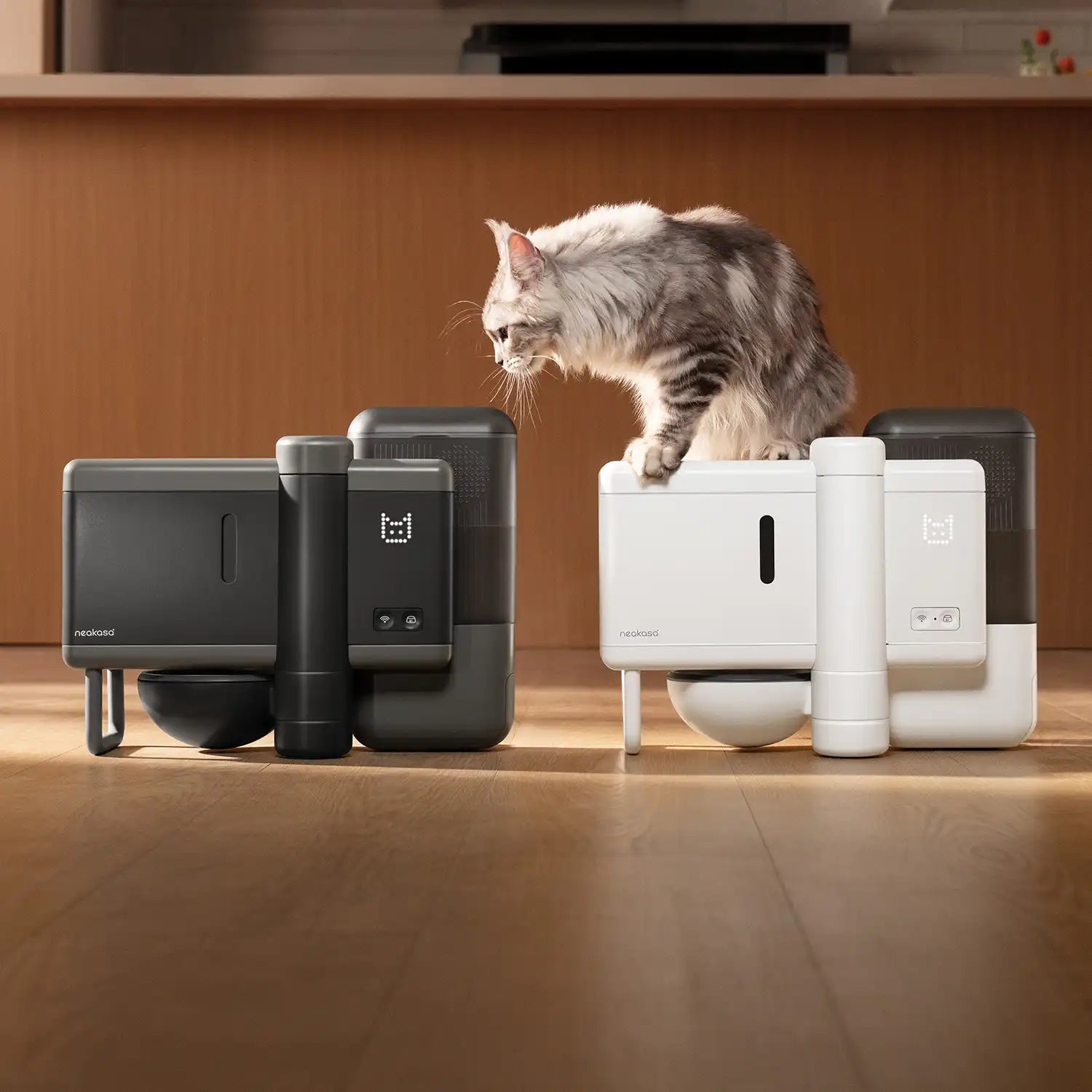
Neakasa Riko is our featured choice for cat parents who feed compatible freeze-dried complete food and want freshly rehydrated meals on a schedule. It takes a different approach from both a standard kibble dispenser and a chilled wet-food tray.
Instead of releasing dry pieces into the bowl or holding prepared wet food for later, Riko grinds a measured amount of freeze-dried food and mixes it with room-temperature water at serving time.

- Fresh-Made Meals with Automatic Grinding and Rehydration
- Adjustable Water-to-Food Ratio for Tailored Hydration
- Support more than 20 meals
- App-Controlled Portions, Feeding Schedules, and Smart Alerts
Why Riko Is Different From a Typical Automatic Feeder
A conventional dry-food dispenser automates timing and portions but does not change the meal. A conventional wet-food feeder usually requires the owner to open and portion the food in advance. Riko automates part of the meal-preparation process itself. The food and water remain separate until the scheduled feeding, helping preserve the storage advantages of dry freeze-dried food while creating a softer, moisture-rich meal for the bowl.
How Riko Prepares Each Meal
- Add a compatible freeze-dried complete cat food to the sealed 3-liter food container.
- Fill the 2.4-liter water tank with clean, room-temperature water.
- Use the app to set meal times, food portions, and the food-to-water ratio.
- At mealtime, Riko measures and grinds the freeze-dried food.
- The feeder adds the selected amount of water and dispenses the rehydrated meal.
- The app records feeding activity and helps owners review food and water use.
Key Riko Features for US Cat Parents
| Feature | Riko specification | Why it matters |
|---|---|---|
|
Food storage |
3 L sealed container with desiccant |
Helps protect compatible freeze-dried food from ambient moisture |
|
Water storage |
2.4 L tank |
Keeps water separate until the meal is prepared |
|
Hydration settings |
Food-to-water ratio from 1:1 to 1:5 |
Lets owners adjust the amount of added water within supported settings |
|
Portion range |
1-20 g per serving |
Supports small scheduled portions |
|
Meal frequency |
More than 20 meals per day |
Enables highly divided feeding schedules |
|
Portion accuracy |
Up to +/-1 g under specified conditions |
Helps create a more consistent routine |
|
Connectivity |
Bluetooth Low Energy and 2.4 GHz Wi-Fi |
Supports setup, app control, records, and alerts |
|
Cleaning |
Removable food container, water tank, and bowl |
Makes routine washing and refilling more manageable |
As a general capacity reference, Riko can support up to about 10 days for one approximately 12-pound adult cat. Actual duration varies with the cat's calorie needs, the density and feeding directions of the chosen food, portion settings, meal frequency, hydration ratio, and water use. Capacity should never be treated as a substitute for regular in-person checks.
Who Riko Is Best For
- Cats already eating, or transitioning to, a compatible freeze-dried complete food.
- Owners who want to add water to scheduled meals without preparing each portion by hand.
- Cats that benefit from a daily allowance divided into many small meals.
- Households that want app-based scheduling and feeding records.
- Owners who prefer food and water to remain separate until serving time.
💡 Note: Neakasa Riko is designed for compatible freeze-dried cat food. It is not a refrigerated storage feeder for canned, pouch, homemade, or already rehydrated wet food.
How to Choose the Best Automatic Cat Feeder
1. Start With Your Cat's Food Type
List exactly what your cat eats: kibble, conventional wet food, compatible freeze-dried complete food, a therapeutic diet, or a combination. Then eliminate any feeder that does not explicitly support that format. Food compatibility affects dispensing, freshness, cleaning, and safety, so it should be decided before capacity, color, camera features, or price.
2. Check Portion Size and Accuracy
Compare the smallest and largest serving, how the feeder defines a portion, and whether output changes with food size or shape. If a product uses portions rather than grams, test several servings and weigh them. For a cat with a tightly controlled diet, small differences can add up across many daily meals.
3. Consider the Number of Daily Meals
Choose a feeder that can accommodate your current routine and reasonable future changes. A cat that eats two larger meals has different needs from a cat that receives six or more small meals. Make sure the schedule is easy to edit and that a manual feeding does not accidentally disrupt the remaining daily plan.
4. Look at Capacity and Physical Design
Capacity should match the interval between refills, not the maximum number printed on the box. Consider the feeder's footprint, bowl width and depth, stability, cord placement, and access for refilling. Cats that are sensitive to whisker contact may prefer a wider, shallower eating surface. Measure the intended location before buying.
5. Evaluate Freshness and Food Safety
Dry food should be protected from moisture and pests. Prepared conventional wet food needs appropriate temperature management. Rehydrated food should not remain in the bowl indefinitely. Wash your hands and food-contact surfaces, follow the food manufacturer's handling directions, and discard uneaten food according to those directions. The US Food and Drug Administration also notes that raw pet food, including some raw freeze-dried products, can carry pathogens such as Salmonella and Listeria. Choose and handle food with that risk in mind.
6. Review App and Connectivity Features
For a connected feeder, verify the supported Wi-Fi band, device-sharing options, notification types, privacy settings, and any subscription requirements. Confirm that scheduled meals continue if the internet goes down. Bluetooth may help with initial pairing, but reliable local execution is what keeps a routine running during a temporary network interruption.
7. Check Cleaning and Maintenance
Food residue, oils, crumbs, and standing water can collect in parts that are easy to overlook. Favor removable bowls and tanks, accessible food paths, and clear cleaning instructions. Check which components can go in a dishwasher and which require hand washing. Clean more frequently when a feeder handles water or moist food than when it dispenses dry kibble alone.
8. Plan for Power and Internet Outages
Determine whether the feeder has battery backup, whether it retains its schedule after losing power, and whether food can be served manually. Do not wait for an emergency to test these functions. If you will be away, leave clear instructions and make sure a caregiver knows how to feed the cat without the machine.
9. Consider Your Cat's Behavior
Some cats pry at food outlets, tip lightweight units, eat too quickly, or avoid unfamiliar motor sounds. Multi-cat dynamics can create additional problems around a shared bowl. Introduce the feeder gradually, observe several complete feeding cycles, and confirm that the cat is comfortable before relying on it during an absence.
Automatic Cat Feeder Comparison Checklist
| Question | What to check |
|---|---|
|
What does my cat eat? |
Dry food, conventional wet food, compatible freeze-dried complete food, or a prescribed diet |
|
How many meals are needed? |
Maximum schedules and smallest serving size |
|
Does my cat need added water? |
Rehydration capability and adjustable water ratio |
|
Will multiple cats use it? |
Access control, food stealing, and separate feeding spaces |
|
How long will I be away? |
Capacity, alerts, backup plan, and human check-ins |
|
Is it easy to clean? |
Removable bowl, tank, hopper, and accessible food path |
|
What happens during an outage? |
Battery backup, stored schedule, and manual feeding |
|
Can I monitor feeding? |
App records, alerts, and the limits of shared-bowl data |
Tips for Introducing a New Automatic Feeder
- Set up the feeder several days before you need to rely on it.
- Place it near the familiar bowl and let your cat investigate while it is turned off.
- Use a familiar, compatible food during the transition.
- Trigger a meal while you are present so your cat can become accustomed to the sound.
- Move one meal at a time to the new feeder instead of changing the entire routine overnight.
- Watch your cat eat and verify that a successful dispensing record corresponds to a completed meal.
- In a multi-cat home, observe each cat separately for food guarding or stealing.
- Complete several days of reliable testing before leaving the feeder in charge of a routine.
Common Automatic Feeder Mistakes to Avoid
- Choosing a feeder before confirming food compatibility.
- Assuming automatic dispensing also means automatic refrigeration or food preservation.
- Putting canned or pouch food into a dry-food hopper.
- Ignoring the smallest available serving size.
- Selecting the largest hopper without considering sealing and cleaning.
- Failing to plan for a power, Wi-Fi, or mechanical problem.
- Leaving bowls, food outlets, or water tanks unwashed for too long.
- Using freeze-dried treats as a complete daily diet without checking the label.
- Leaving for several days before the cat has adapted to the machine.
Frequently Asked Questions
What is the best auto feeder for cats?
The best option matches your cat's food and routine. For kibble, prioritize accurate portions, sealing, and anti-jam performance. For canned or pouch meals, use a feeder designed to keep pre-portioned wet food appropriately cool. For compatible freeze-dried complete food served with water, Neakasa Riko stands out because it portions, grinds, and rehydrates the meal at serving time.
Are automatic feeders good for cats?
They can support consistent meal times, portion control, and small frequent meals. They are tools, not substitutes for observation. Owners still need to confirm that the cat is eating, clean the feeder, adjust calories when necessary, and arrange human care during an absence.
Can you put wet food in an automatic cat feeder?
Only place wet food in a feeder specifically designed for it and follow its storage and temperature instructions. A standard dry-food dispenser cannot safely handle canned food.
Can an automatic feeder feed a cat for a week?
A feeder may hold enough food for several days, but capacity alone does not make it safe to leave a cat without supervision. A person should regularly check the cat, feeder, water, litter box, and home. Medical problems, power loss, jams, spills, and appetite changes may not be obvious from an app.
How many times a day should an automatic feeder dispense food?
The schedule should reflect the cat's age, health, calorie target, and existing routine. Many owners divide the daily allowance into several small meals. More feeding events do not mean more total food. Ask a veterinarian for guidance if the cat is a kitten, underweight, overweight, diabetic, or managing another condition.
Can freeze-dried cat food be used in an automatic feeder?
Only when the feeder supports the food format, size, and texture. Standard dispensers may crush or jam on irregular pieces.
Is freeze-dried cat food a complete meal?
Not always. Some products are complete and balanced for a stated life stage, while others are treats, toppers, or foods for intermittent or supplemental feeding. Check the nutritional adequacy statement, calorie content, and feeding directions on the package before using a freeze-dried product as the main diet.
Choosing the Right Feeder for Your Cat
The best auto feeder for cats starts with a simple question: what will the cat actually eat? Dry-food households should focus on consistent portions, sealing, and jam prevention. Conventional wet-food households need a system specifically designed for pre-portioned wet meals and appropriate temperature control.
For cat parents who use compatible freeze-dried complete food and want scheduled meals with added water, Neakasa Riko offers a distinctive solution. It keeps food and water separate, portions 1 to 20 grams, supports a 1:1 to 1:5 food-to-water ratio, allows more than 20 feeding events per day, and provides app-based controls and records. Most importantly, it prepares the rehydrated meal at serving time rather than storing conventional wet food.
Whichever format you choose, introduce it while you are home, verify portion output, maintain a regular cleaning schedule, and keep a backup feeding plan. The right feeder should make your cat's routine more consistent without making the owner less attentive.

Leave a comment
This site is protected by hCaptcha and the hCaptcha Privacy Policy and Terms of Service apply.